In embedded systems design, selecting the right display affects not only the visual output but also the product’s power budget, environmental tolerance, long-term reliability, and total cost. For HMI panels, IoT devices, medical terminals, and industrial controllers, the two display families most often considered are LCD (Liquid Crystal Display) and OLED (Organic Light-Emitting Diode).
This guide provides a technical, engineering-oriented comparison to help you choose the most suitable option for your application.
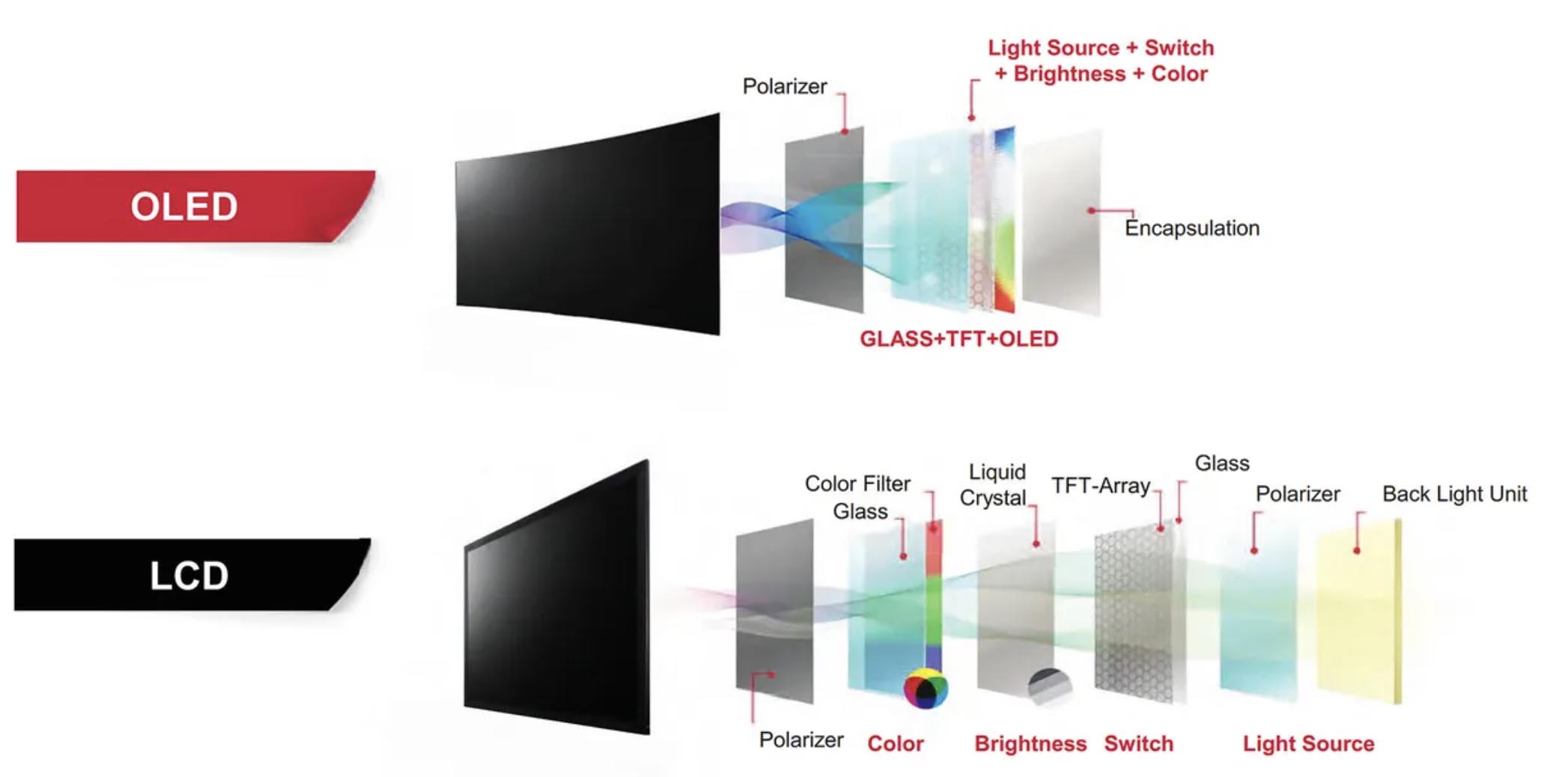
1. How LCD and OLED Technologies Work
LCD
LCD panels rely on a backlight shining through liquid crystal layers that modulate the light to form images. Because the backlight is always active, black levels are limited, but the technology is mature, cost-efficient, and highly stable.
Key characteristics:
- Backlight-based architecture
- Excellent sunlight readability
- Long operating lifetime
- Stable performance across temperature ranges
OLED
OLED pixels are self-emissive—each pixel produces its own light. This allows deeper blacks, higher contrast, and thinner modules, but the organic materials introduce wear concerns.
Key characteristics:
- True blacks and extremely high contrast
- Wide color gamut and viewing angles
- Very thin mechanical structure
- Susceptible to burn-in under static imagery
2. Picture Quality and Contrast
OLEDs outperform LCDs when it comes to perceived image quality:
- **Infinite contrast ratio** due to individually switchable pixels
- No light leakage in dark scenes
- Excellent uniformity
LCDs, even high-quality IPS variants, depend on a constant backlight and therefore:
- Show lower contrast
- May exhibit glow or backlight bleed
- Provide sharp rendering for text-heavy UI common in industrial systems
For many embedded devices with static or simplified UI layouts, LCD quality is more than sufficient.
3. Color Accuracy and Viewing Angle
OLED excels in:
- Wide viewing angles with minimal color shift
- High color saturation and deep blacks
- Premium visual appearance for consumer-facing devices
IPS LCDs offer:
- Good color accuracy at a lower cost
- Better consistency under high brightness or elevated temperatures
- More predictable performance in industrial or outdoor environments
4. Burn-in Risk and Display Longevity
A major distinction:
OLED
- Static elements such as icons, menus, and toolbars can cause permanent burn-in.
- Not ideal for dashboards or 24/7 HMI interfaces.
- Lifetime decreases under high temperature or high brightness operation.
LCD
- Nearly immune to burn-in
- Longer usable life in harsh conditions
- Better suited for mission-critical and always-on devices
For industrial and medical applications with fixed UI layouts, LCD is typically the safer option.
---
5. Power Consumption Differences
OLED power draw depends on image content:
- **Low consumption** for dark themes
- **High consumption** for bright, white-dominant screens common in HMIs
- Can exceed LCD energy usage in many embedded workloads
LCD power is more stable:
- Backlight is the main power consumer
- Efficient LED backlights help maintain predictable consumption
- Often better battery life for dashboards or outdoor displays
6. Integration and Interface Compatibility
LCD modules dominate the embedded market because they offer:
- Broad interface options (RGB, LVDS, MIPI-DSI, eDP)
- Compatibility with most ARM and x86 SoCs
- Wide range of sizes and form factors
- Straightforward electrical and thermal design
OLED modules:
- Fewer interface variations
- May require special voltage rails and protective circuitry
- Need thermal consideration for sustained high brightness
For system designers, LCD often offers smoother integration with existing platforms.
7. Cost and Supply Chain Considerations
LCD advantages:
- Lower cost across all size ranges
- Mature manufacturing ecosystem
- Large supplier base with long product lifecycles
- Stable pricing and availability
OLED challenges:
- Higher cost, especially for medium-to-large sizes
- Limited industrial-grade supply
- Potentially longer lead times
- More variability between panel revisions
For cost-sensitive or high-volume embedded deployments, LCD usually provides better value.
8. Recommended Use Cases
Application Category |
Preferred Display |
Rationale |
Industrial HMI panels |
LCD |
Long life, burn-in resistance, high brightness |
Medical UI systems |
IPS LCD / OLED |
OLED for premium clarity; LCD for stability |
Wearables & small IoT |
OLED |
Thin design, attractive visuals |
Automotive interior displays |
OLED (budget permitting) |
Wide viewing angles, deep contrast |
Outdoor devices |
High-brightness LCD |
Superior sunlight readability |